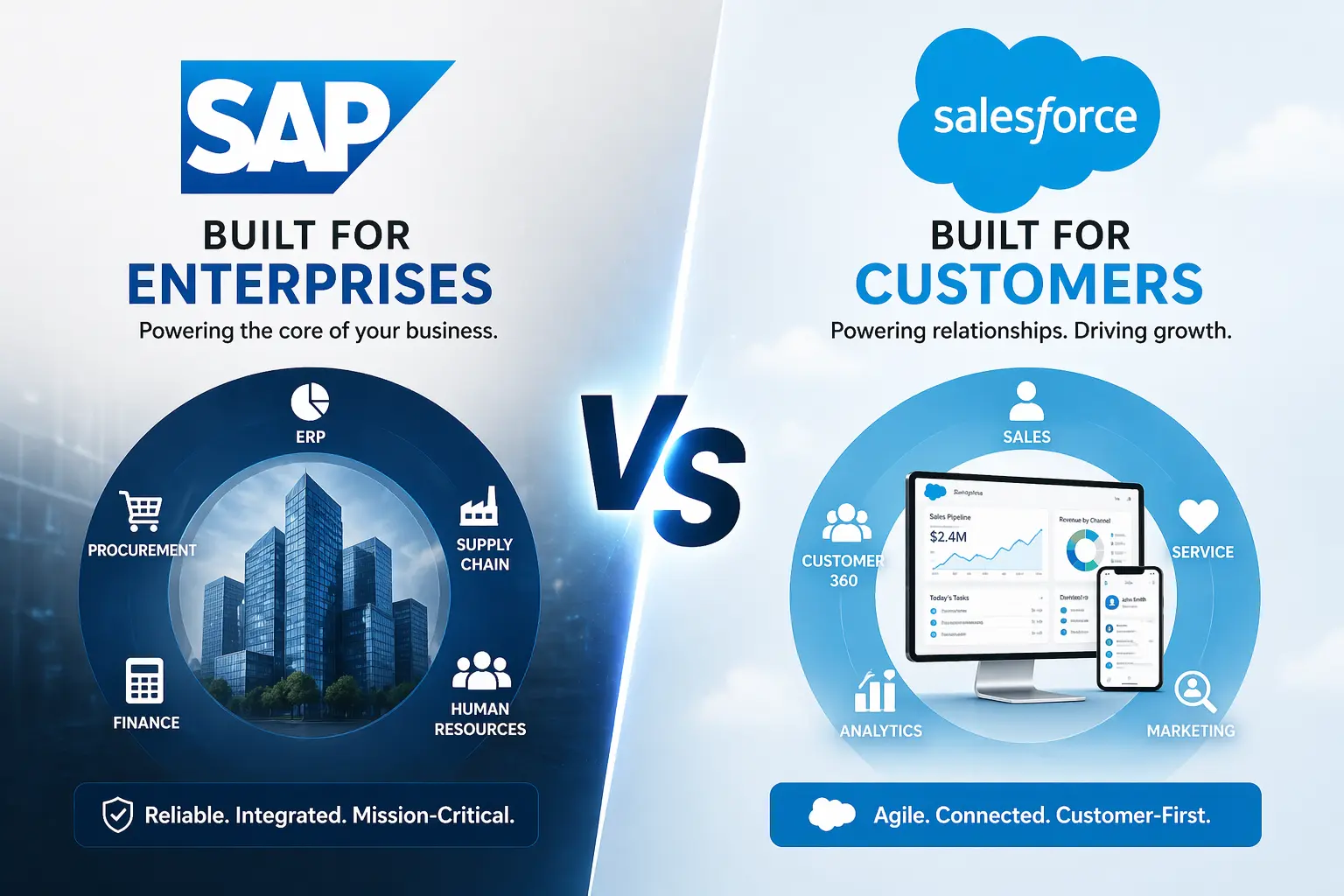
If you spend any time in the corporate technology space, you’ve undoubtedly heard the debate: Salesforce vs SAP. Which is better? Which is the future? Where should I invest my company’s budget, or more importantly, my career?
In 2026, this debate continues to dominate boardrooms and tech forums alike. But framing it as a direct “versus” battle is actually the first massive mistake most people make.
To put it bluntly: comparing Salesforce and SAP is like comparing the engine of a car to its steering wheel. One dictates where you are going and how you interact with the world, while the other provides the heavy-duty operational power required to keep the whole machine moving forward. One is the undisputed king of Customer Relationship Management (CRM), while the other is the absolute titan of Enterprise Resource Planning (ERP).
They are two very different giants, playing two fundamentally different games. Yet, as both companies expand their capabilities, buy up competitors, and race toward an AI-driven future, their boundaries are beginning to blur.
The smartest, most profitable enterprises in 2026 don’t choose between them—they run both. This definitive, long-form guide cuts through the marketing noise. We are going to dive deep into real market statistics, stakeholder verdicts, comprehensive career insights, and a brutal analysis of their AI capabilities to help you understand which platform matters more for your specific business or career path.
Part 1: Two Giants, Two Completely Different Games
To understand the Salesforce vs SAP dynamic, we have to look at the anatomy of a modern business. Every business is split into two halves: the “Front Office” and the “Back Office.”
Year-Over-Year Revenue Growth Trend
Salesforce Total Revenue Growth vs SAP Cloud Revenue Growth (2023-2026)
The Front Office: Enter Salesforce
Salesforce manages the front office. Born in 1999 in a rented San Francisco apartment, Salesforce revolutionized software by delivering it over the internet (the birth of SaaS – Software as a Service). Its core mission was simple: help companies sell better.
Today, Salesforce is the central nervous system for how a company interacts with the outside world. It tracks leads, manages sales pipelines, runs marketing campaigns, and handles customer service tickets. If it touches the customer, Salesforce owns it.
The Salesforce Profile in 2026:
- Core Philosophy: The Customer 360 view. Putting the customer at the center of every digital interaction.
- Adoption: Over 150,000 companies globally rely on it, including a staggering 90% of the Fortune 500.
- Ecosystem: The AppExchange remains the largest enterprise software app store in the world, boasting over 5,000 custom integrations.
- The Vibe: Agile, user-friendly, sales-driven, and highly focused on user experience (UX).
The Back Office: Enter SAP
SAP manages the back office. Founded in 1972 by five former IBM engineers in Germany, SAP (Systems, Applications, and Products in Data Processing) was built to solve the most complex, math-heavy, regulatory-strict problems a massive corporation could face.
SAP is the operational backbone. It doesn’t care if a customer liked your latest marketing email; it cares that the raw materials required to build your product are sourced, paid for, manufactured, stored, and shipped efficiently. It handles global payroll, complex international tax compliance, supply chain logistics, and core financial ledgers.
The SAP Profile in 2026:
- Core Philosophy: The Intelligent Enterprise. Creating a single, unified source of truth for all business operations and resources.
- Adoption: Over 141,000 enterprise customers worldwide. While fewer total logos than Salesforce, SAP runs the biggest companies on earth. Notably, 87% of total global commerce is generated by SAP customers.
- Momentum: With the aggressive push to S/4HANA Cloud and the “RISE with SAP” initiative, they have seen massive ~27% year-over-year cloud revenue growth.
- The Vibe: Highly structured, incredibly robust, complex, and unyielding. It is the definition of “mission-critical.”
The Golden Rule: Salesforce is the charismatic salesperson closing the multi-million dollar deal. SAP is the meticulous accountant and supply chain manager ensuring the product is actually built, delivered, and accounted for legally.
Part 2: The Numbers Don’t Lie – 2026 Market Data & Financials
When we look at the financials in 2026, we see a fascinating neck-and-neck race. Independent research from firms like IDC and Gartner shows just how dominant these two are, albeit in different sectors.
Salesforce Revenue
$41.5B
Fiscal Year 2026
+9.6% Year-over-Year Growth
SAP Revenue
€36.8B
Approx. $40.5B USD (FY 2025)
Cloud ERP Suite up 32% YoY
Revenue Tie: The $35 Billion Club
If you look at the most recent fiscal year reports, both companies are hovering right around the ~$35 Billion USD annual revenue mark. This is a testament to how essential both CRM and ERP software have become.
However, how they generate that revenue tells the real story:
Global CRM Market Share Dominance (2025/2026)
- Salesforce makes its money by dominating a specific software category. It holds roughly a 20.7% market share in the global CRM market. To put that in perspective, Salesforce is larger than its next four competitors (Microsoft, Oracle, SAP, and Adobe) combined in the CRM space.
- SAP makes its money through sheer operational scale. Their Cloud ERP Suite has been exploding, growing at roughly 35% as legacy on-premise customers finally make the leap to the cloud. SAP is heavily dominant in manufacturing, pharmaceuticals, and global logistics.
Why is SAP growing its cloud revenue so fast in 2026?
For years, SAP was criticized as a “legacy dinosaur” because so many of its clients ran on-premise servers. However, the deadline to migrate to their modern cloud platform (S/4HANA) has forced the hands of Fortune 500s worldwide. This massive migration wave has turned SAP into a darling for Wall Street investors looking for sustainable, locked-in cloud revenue.
Part 3: Deep-Dive Feature Scorecard & Comparison
Let’s break away from the high-level philosophy and look at how these platforms actually perform in the trenches. We’ve graded them across ten critical dimensions of enterprise software based on feedback from CIOs, developers, and daily users in 2026.
Platform Capability Analysis
Scored out of 10 across key enterprise dimensions
1. Ease of Use and User Interface (UI)
- Salesforce (9.0/10): Salesforce’s Lightning Experience is intuitive, modern, and acts a lot like the consumer apps we use every day on our phones. Training a new sales rep to use Salesforce takes days, not months.
- SAP (6.0/10): SAP has made massive strides with its Fiori interface, which is lightyears ahead of its old, grey GUI screens. However, because SAP handles such complex backend data, the interface remains inherently complicated.
- Winner: Salesforce.
2. CRM & Sales Automation
- Salesforce (10/10): This is their home turf. From lead routing to complex territory management, quoting, and pipeline forecasting, nobody beats Sales Cloud.
- SAP (6.5/10): SAP has a CRM (SAP Customer Experience, formerly C/4HANA). It is highly functional, especially if a company is already using SAP ERP, but it lacks the third-party ecosystem and sheer agility of Salesforce.
- Winner: Salesforce.
3. ERP, Finance & Accounting
- Salesforce (4.0/10): Salesforce is not an ERP. While you can use third-party apps like FinancialForce (now Certinia) built on the Salesforce platform to do accounting, it is not designed to run the general ledger of a multi-national conglomerate.
- SAP (10/10): SAP is the gold standard for enterprise finance. It handles multiple currencies, complex international tax laws, and massive ledgers without breaking a sweat.
- Winner: SAP.
4. Supply Chain & Manufacturing
- Salesforce (2.0/10): Salesforce tracks what was sold, but it cannot tell a factory floor in Taiwan how much raw aluminum to order based on predictive seasonal demand.
- SAP (10/10): SAP’s Materials Management (MM) and Production Planning (PP) modules are legendary. They run the supply chains of companies like Apple, Coca-Cola, and BMW.
- Winner: SAP.
5. Customization and Development
- Salesforce (8.5/10): Salesforce uses a proprietary language called Apex (similar to Java). It is incredibly easy to customize using low-code/no-code tools (Flows). You can build custom applications very quickly.
- SAP (8.5/10): SAP uses ABAP and, increasingly, modern languages via the SAP Business Technology Platform (BTP). Customizing SAP is much harder and more expensive than Salesforce, but the depth to which you can customize core business logic is virtually limitless.
- Winner: Tie. (Salesforce wins on speed, SAP wins on depth).
6. Implementation Speed and Total Cost of Ownership (TCO)
- Salesforce (7.5/10): You can stand up a basic Salesforce instance for a mid-sized company in 3 to 6 months. However, licensing costs per user are notoriously high, and add-ons accumulate quickly.
- SAP (4.0/10): Implementing SAP S/4HANA is a multi-year, multi-million-dollar endeavor. It is not uncommon for an enterprise SAP rollout to take 2 to 5 years. It is a fundamental rewiring of a company’s operational brain.
- Winner: Salesforce (for speed to value).
7. Ecosystem and Third-Party Integrations
- Salesforce (9.5/10): With the acquisition of MuleSoft and the massive AppExchange, integrating Salesforce with almost any modern web tool (Slack, Google Workspace, AWS) is seamless.
- SAP (8.0/10): SAP BTP has improved things drastically, and SAP naturally integrates well with other enterprise tools, but it remains a more closed ecosystem compared to Salesforce’s open-API culture.
- Winner: Salesforce.
Part 4: The 2026 AI Race – Agentforce vs. SAP Joule
You cannot talk about enterprise software in 2026 without talking about Artificial Intelligence. The era of basic “generative AI” (writing emails or summarizing text) is over. We are now in the era of Agentic AI—systems that can make autonomous decisions and take action without human intervention.
Both companies are pouring billions into this, but their strategies perfectly reflect their distinct DNA.
Salesforce: The Agentforce Revolution
Salesforce has pivoted its entire identity around Agentforce (the evolution of Einstein AI). Salesforce’s AI is highly visible, customer-facing, and aggressive.
- How it works: You can deploy autonomous “Agents” to act as Level 1 customer support, SDRs (Sales Development Reps), or marketing campaign managers.
- The impact: An Agentforce bot can read an incoming email from a disgruntled customer, access their order history in Data Cloud, issue a refund, and send a personalized apology email—all in three seconds, without a human ever touching a keyboard.
- The Verdict: Salesforce is winning the “visible” AI war. Their AI directly interacts with consumers, making it highly disruptive in the short term for sales and service jobs.
SAP: The Power of Joule
SAP’s AI co-pilot, Joule, takes a completely different approach. It is deeply embedded into the back office. It is not talking to angry retail customers; it is talking to your Chief Supply Chain Officer.
- How it works: Joule understands the complex web of global operations. A supply chain manager can ask Joule, “How will the port strike in Europe affect our Q3 manufacturing capabilities?”
- The impact: Joule can instantly analyze millions of rows of supplier data, alternative shipping routes, current inventory levels across global warehouses, and financial forecasts, delivering a comprehensive mitigation strategy in seconds.
- The Verdict: SAP’s AI is less flashy, but arguably more valuable at scale. Automating a multi-billion-dollar global supply chain saves exponentially more money than automating a customer service chat.
Part 5: The Ultimate Integration – Quote-to-Cash
If you are a Fortune 500 company, the reality is that you don’t choose between these platforms. You integrate them. The holy grail of enterprise architecture in 2026 is a seamless “Quote-to-Cash” process bridging both systems.
Here is what that looks like in the real world:
- Marketing (Salesforce): A prospect clicks a targeted ad generated by Salesforce Marketing Cloud.
- Sales (Salesforce): The prospect becomes a lead. A sales rep works the deal in Sales Cloud and generates a complex price quote using Salesforce CPQ (Configure, Price, Quote).
- The Handoff (The Integration): The customer signs the contract. Boom! Salesforce talks to SAP via middleware (like MuleSoft).
- Fulfillment (SAP): SAP instantly receives the order, alerts the warehouse to pick the inventory, calculates the shipping logistics, and dispatches the product.
- Finance (SAP): SAP automatically generates the invoice, records the revenue in the general ledger, and tracks the customer’s payment.
When Salesforce and SAP are integrated correctly, a business becomes an unstoppable machine.
Part 6: Career & Salary Guide – Where is the Money in 2026?
Choosing a software ecosystem to specialize in is one of the most lucrative career decisions you can make in the modern tech economy. Based on global 2026 salary data and recruitment trends, here is exactly what you need to know about the job market.
The Salesforce Career Path
- The Barrier to Entry: Very low. Salesforce Trailhead is arguably the best free, gamified learning platform in the world. Anyone with an internet connection can learn Salesforce and earn certifications.
- The Job Market: Massive volume. Because hundreds of thousands of small-to-medium businesses use Salesforce, there are thousands of entry-level Administrator roles.
- Who it’s for: Career changers, fresh college graduates, marketing professionals, and those who enjoy working closely with business stakeholders.
The SAP Career Path
- The Barrier to Entry: Very high. SAP is notoriously difficult to learn on your own without enterprise access. It requires a deep understanding of business processes (like accounting principles or supply chain logistics), not just software clicks.
- The Job Market: Lower volume, but incredibly high demand for seasoned experts. A senior SAP architect who understands S/4HANA migration is basically handed a blank check in 2026.
- Who it’s for: Accounting professionals, industrial engineers, highly technical systems architects, and those who prefer backend logic over frontend design.
2026 Global Salary Breakdown
| Job Role | Platform Focus | Average US Salary Range | India Market (LPA) |
|---|---|---|---|
| Platform Administrator | Salesforce | $75,000 – $110,000 | 4L – 9L |
| FICO (Finance) Consultant | SAP | $110,000 – $165,000 | 10L – 20L |
| Software Developer | Salesforce | $100,000 – $145,000 | 7L – 16L |
| S/4HANA Supply Chain Expert | SAP | $130,000 – $185,000 | 15L – 30L |
| Solutions Architect | Salesforce | $155,000 – $215,000 | 18L – 32L |
| Enterprise ERP Architect | SAP | $160,000 – $240,000+ | 22L – 45L+ |
The Career Verdict: If you want a fast, accessible entry into a lucrative tech career, choose Salesforce. If you are willing to study complex business operations and want a highly secure, premium-paying career with zero risk of the market becoming oversaturated with talent, specialize in SAP.
Part 7: The Final Verdict – Who Should Choose What?
The ‘Salesforce vs SAP’ narrative is a trap. The true measure of success isn’t comparing features in a vacuum; it’s aligning the software’s core competency with your immediate business goals.
If you are a decision-maker standing at the crossroads in 2026, here is your definitive blueprint:
You Must Choose Salesforce If…
- You are obsessed with Revenue Growth: Your primary business problems are lead generation, sales conversion rates, and customer retention.
- You are an SME (Small to Medium Enterprise): You don’t have $5 million and two years to wait for a software rollout. You need an agile CRM up and running in 90 days.
- You require AI-first customer interactions: You want to leverage Agentforce to automate your customer service and sales outreach immediately.
- Your product is digital or service-based: You don’t have massive physical warehouses, complex manufacturing plants, or global supply chains to worry about.
You Must Choose SAP If…
- Operational efficiency is your lifeblood: You operate in manufacturing, pharmaceuticals, oil & gas, or global retail logistics. A 1% delay in your supply chain costs you millions.
- You have complex regulatory requirements: You operate across dozens of countries, multiple currencies, and strict international tax frameworks.
- You are scaling past $500M in revenue: You have outgrown QuickBooks or mid-tier accounting software and need a single, unbreakable source of truth for your entire enterprise’s finances.
- You want the ultimate operational AI: You need an AI (Joule) that can predict supply chain bottlenecks and optimize global production schedules.
The Final Word:
In 2026, the digital landscape is unforgiving. If your goal is to build relationships and conquer the market, buy Salesforce. If your goal is to build products, manage immense scale, and run the world’s backend, buy SAP. And if you plan on becoming a Fortune 500 powerhouse?
Prepare to write a check to both.